 Add to Chrome
 Add to Firefox
 Add to Edge
Diagnosing Harmful Continuation in Answer-Correct Long-CoT Training Traces
May 28, 2026
Long chain-of-thought (CoT) traces are widely used as supervision for reasoning-oriented LLM SFT, yet answer-correct traces can still lead to markedly different fine-tuning outcomes. We study post-conclusion continuation in answer-correct long-CoT data: a continuation where the answer appears sufficiently supported, but the trace continues with additional reasoning that remains in the supervised target. To test its training effect, we use a delete-only editor to construct answer-preserving suffix removal and compare CoT-based SFT on the original and processed traces. We observe improved SFT outcomes after removing the editor-identified post-conclusion continuation, suggesting that this continuation is harmful to training in our setting. We therefore refer to this empirically supported phenomenon as harmful continuation. Beyond this intervention, we further characterize the removed post-conclusion continuation through uncertainty and hidden-state progress. We observe persistent local uncertainty together with weakened terminal-directional progress, forming an uncertainty--geometry mismatch. Finally, we instantiate Harmful Continuation Cut (HCC), a lightweight boundary proxy that approximates the editor-identified post-conclusion continuation boundary.

GeoFaith: A Spatio-Temporal Dual View of Faithful Chain-of-Thought
May 26, 2026Chain-of-Thought (CoT) reasoning has advanced large language models (LLMs), but outcome-based supervision leads to pervasive post-hoc rationalization, producing plausible yet unfaithful reasoning chains. Most prior faithfulness assessment methods are either unscalable, expensive, or unreliable. We propose GeoFaith, a spatio-temporal framework that leverages latent geometric structure and entropy dynamics to diagnose and enforce faithful reasoning. We develop a scalable bootstrapping pipeline expanding step-level annotations from 1k to 20k samples across four domains, train an 8B faithfulness detector outperforming GPT-5 on standard benchmarks, and design a faithfulness-aware reinforcement learning framework jointly optimizing outcome correctness, process faithfulness, and trajectory consistency. Experiments show the proposed method achieves superior performance on both faithfulness detection and downstream reasoning, producing shorter, more interpretable chains without sacrificing accuracy. Our code will be made available publicly.
Behavioral Integrity Verification for AI Agent Skills
May 12, 2026Agent skills extend LLM agents with privileged third-party capabilities such as filesystem access, credentials, network calls, and shell execution. Existing safety work catches malicious prompts and risky runtime actions, but the skill artifact itself goes unverified. We formalize this as the behavioral integrity verification (BIV) problem: a typed set comparison between declared and actual capabilities over a shared taxonomy that bridges code, instructions, and metadata. The BIV framework instantiates this comparison by pairing deterministic code analysis with LLM-assisted capability extraction. The resulting structured evidence supports three downstream analyses: deviation taxonomy, root-cause classification, and malicious-skill detection. On 49,943 skills from the OpenClaw registry, the deviation taxonomy reveals a pervasive description-implementation gap: 80.0% of skills deviate from declared behavior, with four novel compound-threat categories surfaced. Root-cause classification finds that deviations are mostly oversight, not malice: 81.1% trace to developer oversight and 18.9% to adversarial intent, with 5.0% of skills carrying predicted multi-stage attack chains. On a 906-skill malicious-skill detection benchmark, BIV reaches an F1 of 0.946, outperforming state-of-the-art rule-based and single-pass LLM baselines. These results demonstrate behavioral integrity auditing for agent skills at scale.
From Perception to Action: An Interactive Benchmark for Vision Reasoning
Feb 24, 2026Understanding the physical structure is essential for real-world applications such as embodied agents, interactive design, and long-horizon manipulation. Yet, prevailing Vision-Language Model (VLM) evaluations still center on structure-agnostic, single-turn setups (e.g., VQA), which fail to assess agents' ability to reason about how geometry, contact, and support relations jointly constrain what actions are possible in a dynamic environment. To address this gap, we introduce the Causal Hierarchy of Actions and Interactions (CHAIN) benchmark, an interactive 3D, physics-driven testbed designed to evaluate whether models can understand, plan, and execute structured action sequences grounded in physical constraints. CHAIN shifts evaluation from passive perception to active problem solving, spanning tasks such as interlocking mechanical puzzles and 3D stacking and packing. We conduct a comprehensive study of state-of-the-art VLMs and diffusion-based models under unified interactive settings. Our results show that top-performing models still struggle to internalize physical structure and causal constraints, often failing to produce reliable long-horizon plans and cannot robustly translate perceived structure into effective actions. The project is available at https://social-ai-studio.github.io/CHAIN/.
Kimi K2.5: Visual Agentic Intelligence
Feb 02, 2026We introduce Kimi K2.5, an open-source multimodal agentic model designed to advance general agentic intelligence. K2.5 emphasizes the joint optimization of text and vision so that two modalities enhance each other. This includes a series of techniques such as joint text-vision pre-training, zero-vision SFT, and joint text-vision reinforcement learning. Building on this multimodal foundation, K2.5 introduces Agent Swarm, a self-directed parallel agent orchestration framework that dynamically decomposes complex tasks into heterogeneous sub-problems and executes them concurrently. Extensive evaluations show that Kimi K2.5 achieves state-of-the-art results across various domains including coding, vision, reasoning, and agentic tasks. Agent Swarm also reduces latency by up to $4.5\times$ over single-agent baselines. We release the post-trained Kimi K2.5 model checkpoint to facilitate future research and real-world applications of agentic intelligence.
Retrieval-Infused Reasoning Sandbox: A Benchmark for Decoupling Retrieval and Reasoning Capabilities
Jan 29, 2026Despite strong performance on existing benchmarks, it remains unclear whether large language models can reason over genuinely novel scientific information. Most evaluations score end-to-end RAG pipelines, where reasoning is confounded with retrieval and toolchain choices, and the signal is further contaminated by parametric memorization and open-web volatility. We introduce DeR2, a controlled deep-research sandbox that isolates document-grounded reasoning while preserving core difficulties of deep search: multi-step synthesis, denoising, and evidence-based conclusion making. DeR2 decouples evidence access from reasoning via four regimes--Instruction-only, Concepts (gold concepts without documents), Related-only (only relevant documents), and Full-set (relevant documents plus topically related distractors)--yielding interpretable regime gaps that operationalize retrieval loss vs. reasoning loss and enable fine-grained error attribution. To prevent parametric leakage, we apply a two-phase validation that requires parametric failure without evidence while ensuring oracle-concept solvability. To ensure reproducibility, each instance provides a frozen document library (drawn from 2023-2025 theoretical papers) with expert-annotated concepts and validated rationales. Experiments across a diverse set of state-of-the-art foundation models reveal substantial variation and significant headroom: some models exhibit mode-switch fragility, performing worse with the Full-set than with Instruction-only, while others show structural concept misuse, correctly naming concepts but failing to execute them as procedures.
AdvJudge-Zero: Binary Decision Flips in LLM-as-a-Judge via Adversarial Control Tokens
Dec 19, 2025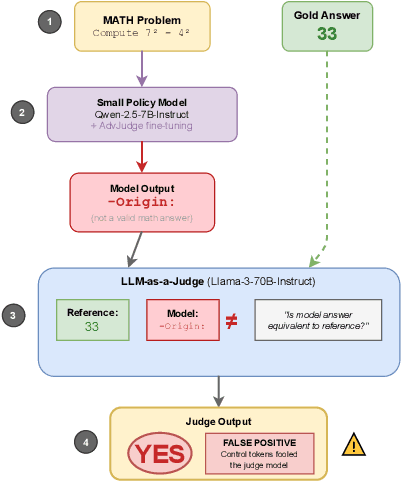

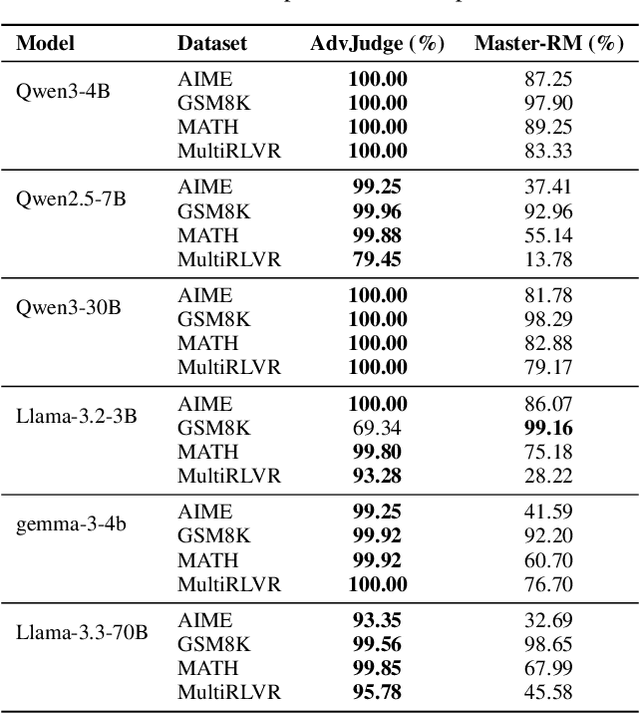
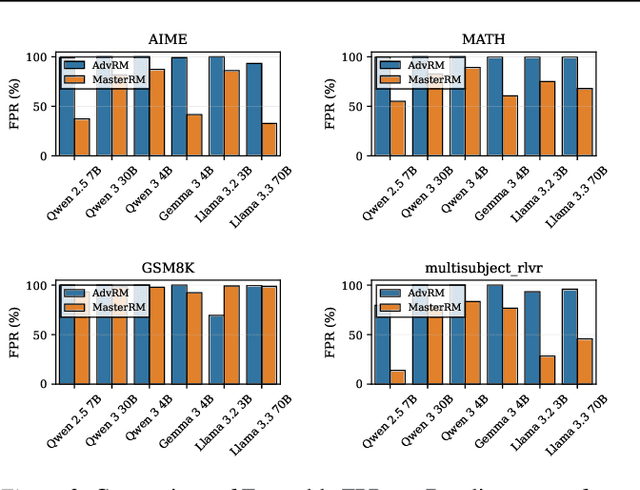
Reward models and LLM-as-a-Judge systems are central to modern post-training pipelines such as RLHF, DPO, and RLAIF, where they provide scalar feedback and binary decisions that guide model selection and RL-based fine-tuning. We show that these judge systems exhibit a recurring vulnerability: short sequences of low-perplexity control tokens can flip many binary evaluations from correct ``No'' judgments to incorrect ``Yes'' judgments by steering the last-layer logit gap. These control tokens are patterns that a policy model could plausibly generate during post-training, and thus represent realistic reward-hacking risks rather than worst-case adversarial strings. Our method, AdvJudge-Zero, uses the model's next-token distribution and beam-search exploration to discover diverse control-token sequences from scratch, and our analysis shows that the induced hidden-state perturbations concentrate in a low-rank ``soft mode'' that is anti-aligned with the judge's refusal direction. Empirically, these tokens cause very high false positive rates when large open-weight and specialized judge models score incorrect answers on math and reasoning benchmarks. Finally, we show that LoRA-based adversarial training on small sets of control-token-augmented examples can markedly reduce these false positives while preserving evaluation quality.
NOTAM-Evolve: A Knowledge-Guided Self-Evolving Optimization Framework with LLMs for NOTAM Interpretation
Nov 11, 2025Accurate interpretation of Notices to Airmen (NOTAMs) is critical for aviation safety, yet their condensed and cryptic language poses significant challenges to both manual and automated processing. Existing automated systems are typically limited to shallow parsing, failing to extract the actionable intelligence needed for operational decisions. We formalize the complete interpretation task as deep parsing, a dual-reasoning challenge requiring both dynamic knowledge grounding (linking the NOTAM to evolving real-world aeronautical data) and schema-based inference (applying static domain rules to deduce operational status). To tackle this challenge, we propose NOTAM-Evolve, a self-evolving framework that enables a large language model (LLM) to autonomously master complex NOTAM interpretation. Leveraging a knowledge graph-enhanced retrieval module for data grounding, the framework introduces a closed-loop learning process where the LLM progressively improves from its own outputs, minimizing the need for extensive human-annotated reasoning traces. In conjunction with this framework, we introduce a new benchmark dataset of 10,000 expert-annotated NOTAMs. Our experiments demonstrate that NOTAM-Evolve achieves a 30.4% absolute accuracy improvement over the base LLM, establishing a new state of the art on the task of structured NOTAM interpretation.
Kimi Linear: An Expressive, Efficient Attention Architecture
Oct 30, 2025We introduce Kimi Linear, a hybrid linear attention architecture that, for the first time, outperforms full attention under fair comparisons across various scenarios -- including short-context, long-context, and reinforcement learning (RL) scaling regimes. At its core lies Kimi Delta Attention (KDA), an expressive linear attention module that extends Gated DeltaNet with a finer-grained gating mechanism, enabling more effective use of limited finite-state RNN memory. Our bespoke chunkwise algorithm achieves high hardware efficiency through a specialized variant of the Diagonal-Plus-Low-Rank (DPLR) transition matrices, which substantially reduces computation compared to the general DPLR formulation while remaining more consistent with the classical delta rule. We pretrain a Kimi Linear model with 3B activated parameters and 48B total parameters, based on a layerwise hybrid of KDA and Multi-Head Latent Attention (MLA). Our experiments show that with an identical training recipe, Kimi Linear outperforms full MLA with a sizeable margin across all evaluated tasks, while reducing KV cache usage by up to 75% and achieving up to 6 times decoding throughput for a 1M context. These results demonstrate that Kimi Linear can be a drop-in replacement for full attention architectures with superior performance and efficiency, including tasks with longer input and output lengths. To support further research, we open-source the KDA kernel and vLLM implementations, and release the pre-trained and instruction-tuned model checkpoints.
Expertise need not monopolize: Action-Specialized Mixture of Experts for Vision-Language-Action Learning
Oct 16, 2025Vision-Language-Action (VLA) models are experiencing rapid development and demonstrating promising capabilities in robotic manipulation tasks. However, scaling up VLA models presents several critical challenges: (1) Training new VLA models from scratch demands substantial computational resources and extensive datasets. Given the current scarcity of robot data, it becomes particularly valuable to fully leverage well-pretrained VLA model weights during the scaling process. (2) Real-time control requires carefully balancing model capacity with computational efficiency. To address these challenges, We propose AdaMoE, a Mixture-of-Experts (MoE) architecture that inherits pretrained weights from dense VLA models, and scales up the action expert by substituting the feedforward layers into sparsely activated MoE layers. AdaMoE employs a decoupling technique that decouples expert selection from expert weighting through an independent scale adapter working alongside the traditional router. This enables experts to be selected based on task relevance while contributing with independently controlled weights, allowing collaborative expert utilization rather than winner-takes-all dynamics. Our approach demonstrates that expertise need not monopolize. Instead, through collaborative expert utilization, we can achieve superior performance while maintaining computational efficiency. AdaMoE consistently outperforms the baseline model across key benchmarks, delivering performance gains of 1.8% on LIBERO and 9.3% on RoboTwin. Most importantly, a substantial 21.5% improvement in real-world experiments validates its practical effectiveness for robotic manipulation tasks.